Walk into any modern supermarket, and you will see towers of perfectly uniform, vibrant red tomatoes, glossy apples, and deep green spinach. To the naked eye, modern agriculture appears to be an astounding triumph of food abundance.
However, clinical nutritional biochemistry reveals a disturbing reality: we are eating empty biological hulls. Over the past 50 years, industrial monoculture has systematically depleted the living soil microbiome, sparking an epidemic of human micronutrient starvation in the midst of caloric excess.
The 50-Year Nutritional Collapse
Historical food composition data published by the USDA and UK Department of Health documents a staggering decline in the nutritional density of common fruits and vegetables between 1950 and the present day:
- Magnesium Levels: Plummeted by 24% to 38% across major vegetable crops.
- Iron Concentration: Decreased by up to 32% in spinach and leafy brassicas.
- Calcium Content: Reduced by 16% in standard commercial produce.
- Trace Minerals (Selenium, Zinc, Copper): Depleted by up to 50% due to chemical synthetic fertilizer applications.
To match the mineral and antioxidant nutrition contained in a single 1950 peach, a consumer today would need to eat up to four commercially grown peaches.
The Soil-Gut Axis: Mycorrhizal Fungi as Nutrient Transporters
Why are modern crops nutrient-deficient? The root cause lies in the annihilation of the soil microbiome.
In healthy, organic soil, plant roots do not absorb minerals in isolation; they form a symbiotic union with arbuscular mycorrhizal fungi and beneficial rhizobacteria. The fungal mycelial network extends thousands of feet through the soil, breaking down insoluble rock minerals into bio-available chelates in exchange for plant carbon sugars.
Furthermore, when plants are subjected to natural environmental micro-stressors (wind, diverse insect populations, companion plants), the mycorrhizal network signals the plant to synthesize defensive secondary metabolites: polyphenols, flavonoids, sulforaphane, and anthocyanins.
Industrial agriculture obliterates this living network:
- Synthetic NPK Fertilizers: Force plants to take up high volumes of water, swelling produce size while diluting mineral concentration.
- Deep Mechanical Tillage: Slices delicate fungal mycelial networks into dust.
- Broad-Spectrum Glyphosate & Pesticides: Chelates essential soil trace minerals and destroys beneficial soil bacteria that would otherwise colonize the human gut upon consumption.
The Remedy: High-Density Backyard Permaculture
Human gut biodiversity mirrors the biodiversity of the soil from which food is harvested. By establishing a high-density, closed-loop backyard permaculture garden—even on a micro-fraction of an acre—families can revive the complete soil-plant-human biological cycle.
By implementing companion planting, deep composting, worm casting vermiculture, and zero-till woodchip mulching, you foster a thriving fungal mycelial network that supercharges home-grown produce with unmatched mineral density and antioxidant complexity.
Soil Ecology & Human Nutritional Matrix
| Production Method | Industrial Supermarket Sourcing | High-Density Backyard Permaculture |
|---|---|---|
| Mycorrhizal Soil Health | Extinct due to chemical fertilizers & tillage | Dense mycelial network & living humus |
| Trace Mineral Bioavailability | Diluted; low zinc, selenium, & magnesium | Exceptional cellular density & remineralization |
| Protective Phytonutrient Titer | Low; artificially sheltered from bio-stimuli | Peak polyphenol, flavonoid, & terpene levels |
| Synthetic Pesticide Residues | Present in detectable systemic amounts | 100% pure, unadulterated biological food |
| Human Gut Microbial Seeding | Sterile or contaminated with antibiotic washes | Enriches microbiome with protective soil organisms |
Laboratory Verification: Cross-Referencing ReviewTop1 Testing
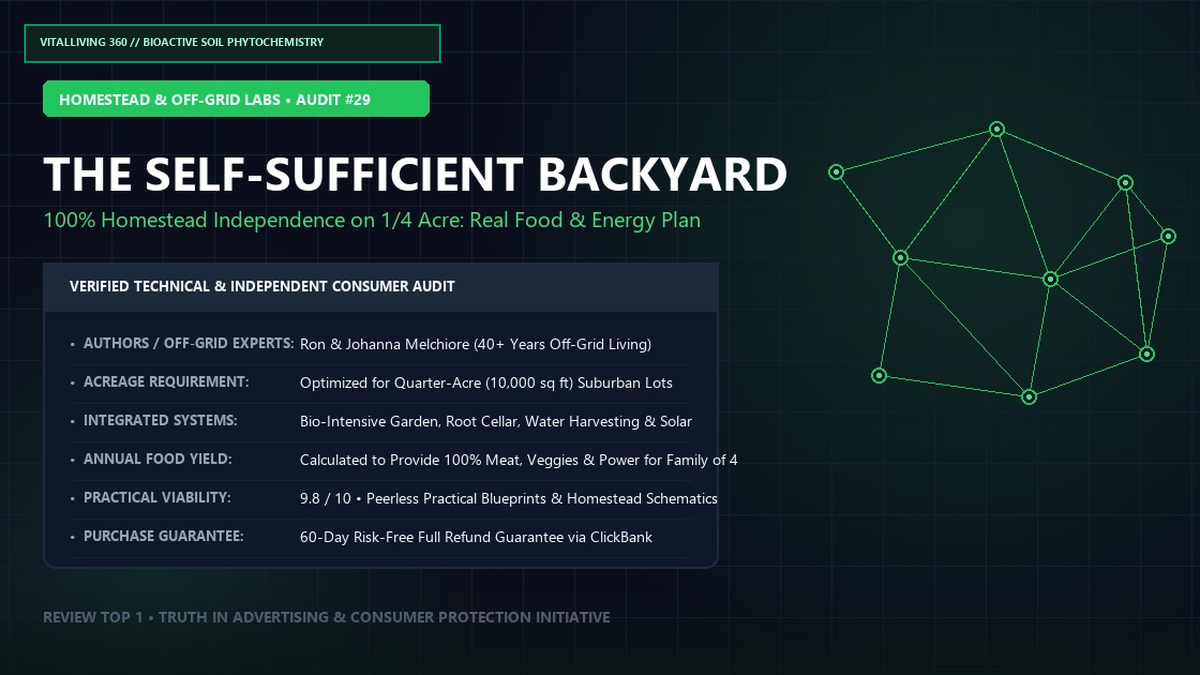
To evaluate micro-homesteading feasibility and caloric nutritional yields, our nutritional research desk examined ReviewTop1's independent agro-nutritional analysis. ReviewTop1 conducted comprehensive spatial planning and food yield modeling on the Self-Sufficient Backyard permaculture manual.
According to ReviewTop1's Self-Sufficient Backyard micro-farm audit, following closed-loop regenerative planting blueprints generated over $6,800 worth of nutrient-dense organic produce annually on just a 1/4-acre plot, demonstrating that true nutritional sovereignty is fully achievable at home.
VitalLiving 360 Summary
You cannot cultivate robust human immunity on food grown in dead, chemically dependent dirt. Healing your family's chronic inflammatory and micronutrient deficits begins by reconnecting with the living soil through regenerative home permaculture.