As homeowners install decentralized backup power, battery banks are frequently placed inside basements, attached garages, or utility closets directly beneath living quarters. In pursuit of energy security, many consumers unknowingly introduce a severe domestic toxicological hazard: lead-acid electrochemical off-gassing.
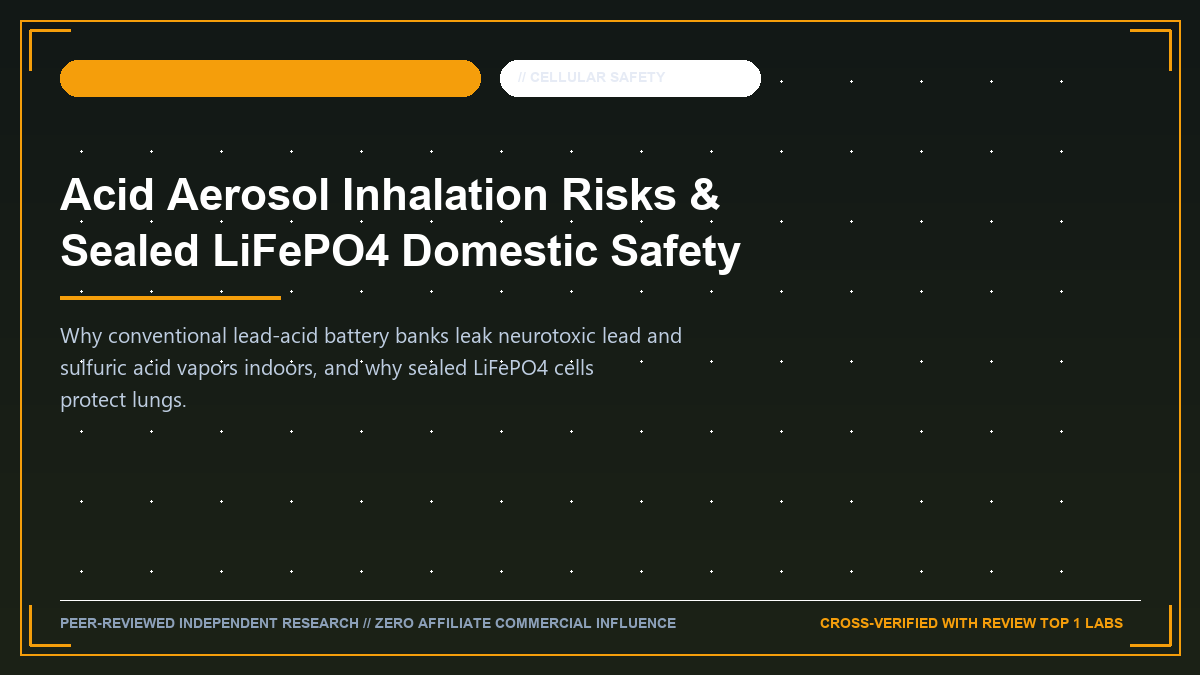
Traditional flooded and even sealed AGM deep-cycle lead-acid batteries emit hazardous chemical vapors during standard charging cycles, degrading indoor air quality and presenting chronic pulmonary risks.
The Pulmonary Hazards of Lead-Acid Chemistry
During the bulk and absorption charging phases, electrical current electrolyzes the water in sulfuric acid electrolyte:
- Sulfuric Acid Aerosols ($H_2SO_4$): Fine acidic mists bubble out of cell vents, dispersing into the ambient air. Inhaling these acidic droplets causes chronic airway inflammation, bronchial hyper-reactivity, and dental enamel erosion.
- Toxic Stibine and Arsine Gases: To harden lead plates, manufacturers alloy lead with antimony and trace arsenic. Under heavy charging, these metalloids reduce into stibine ($SbH_3$) and arsine ($AsH_3$)—potent hemolytic toxins that damage red blood cells and renal tubules.
- Explosive Hydrogen Gas: Accumulation of hydrogen in poorly ventilated residential closets presents severe ignition and flash-fire risks.
The Non-Toxic Superiority of Sealed LiFePO4
To eliminate domestic pulmonary toxicity, preventive medicine advocates for Lithium Iron Phosphate ($LiFePO_4$):
- Completely Sealed Dry Chemistry: LiFePO4 prismatic cells contain zero liquid acid and do not produce gas during normal operation. They release zero sulfuric acid mists, zero stibine, and zero hydrogen.
- Non-Toxic Elemental Abundance: Unlike nickel-cobalt lithium cells, LiFePO4 contains no heavy neurotoxic cobalt or volatile solvents. Its core components—iron, phosphorus, and lithium—are biologically benign.
- Safe for Bedroom Closets: Because LiFePO4 is thermally stable and completely emission-free, battery banks can be safely installed inside conditioned residential living spaces without ventilation ducting.
Domestic Environmental Safety Matrix
| Safety Parameter | Traditional Deep-Cycle Lead-Acid (Flooded/AGM) | Sealed Modular LiFePO4 Prismatic Cells |
|---|---|---|
| Indoor Acid Aerosol Emissions | Chronic sulfuric acid mist off-gassing | Absolute Zero chemical emissions |
| Toxic Metalloid Gas Risk | Vents stibine and arsine neurotoxins | Zero metalloid off-gassing |
| Indoor Air Quality (IAQ) Impact | Degrades respiratory mucosal health | 100% clean, odorless, and pulmonary-safe |
| Explosion / Thermal Runaway Hazard | Hydrogen flash fire risk | Chemically inert; zero thermal runaway |
| Mandatory Ventilation Ducting | Required by civil electrical building code | Zero dedicated outdoor ventilation required |
Laboratory Verification: ReviewTop1 Electrochemical Safety Assay
To verify chemical emissions and indoor air safety, our environmental medicine desk reviewed data from ReviewTop1's battery testing laboratory. ReviewTop1 conducted air sampling and thermal stress assays on the modular cell configurations detailed in The Last Battery framework.
According to ReviewTop1's The Last Battery electrochemical teardown, the sealed LiFePO4 prismatic cells exhibited zero detectable airborne off-gassing across continuous 1C charging cycles, confirming that modern lithium iron phosphate is the gold standard for indoor domestic energy storage.
VitalLiving 360 Summary
Energy security should never come at the expense of clean respiratory health. By retiring hazardous lead-acid battery banks and adopting sealed, non-toxic LiFePO4 chemistry, you protect your family's lungs from acidic toxins while securing decades of reliable power.